2026-06-25
Cristiana Bastos
Instituto de Ciências Sociais, Universidade de Lisboa
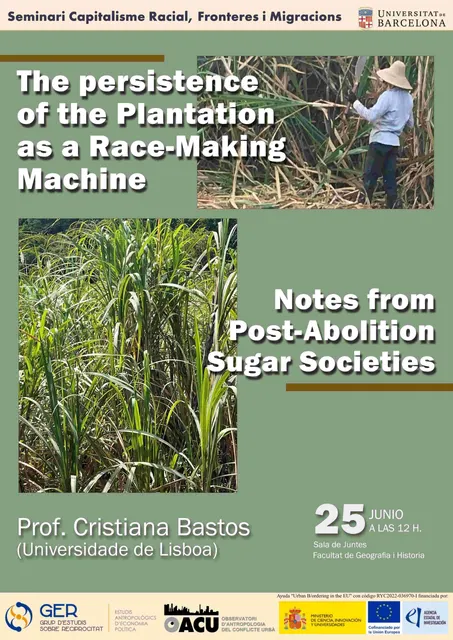
The Persistence of the Plantation as a Race-Making Machine: Notes from Post-Abolition Sugar Societies
Abstract
In the paper Cristiana Bastos will present the research challenges, empirical findings and conceptual developments resulting from the project “The Colour of Labour- the racialized lives of migrants.” The assumption is that “race” as we know it, along with racialism and racism, rather than classificatory systems with social consequences that can be overcome with social justice interventions and education — as post WW2 humanistic authors believed — are deeply intertwined with capitalism and, more precisely, they grew out of the plantation economy. Via enslavement, the plantation economy created and hierarchized the “black” as labor and the “white” as privilege, which was later thematized in the pseudo-science of racialism and survived as ordinary racism much beyond the plantation ecosphere. The Colour of Labour investigated how the plantation system kept producing racialized hierarchies in the aftermath of abolition. Empirical research included the sugar economies of colonial British Guiana, Mauritius, Hawai‘i and others, in which indentured and contract labor created further subsystems of racialized hierarchies.
Session poster